How robotics could turn e-waste into a tech goldmine
The accumulation of electronic waste, ore-waste, has emerged as a critical global challenge. A significant portion of discarded electronic devices ends up in landfills or undergoes

Admin
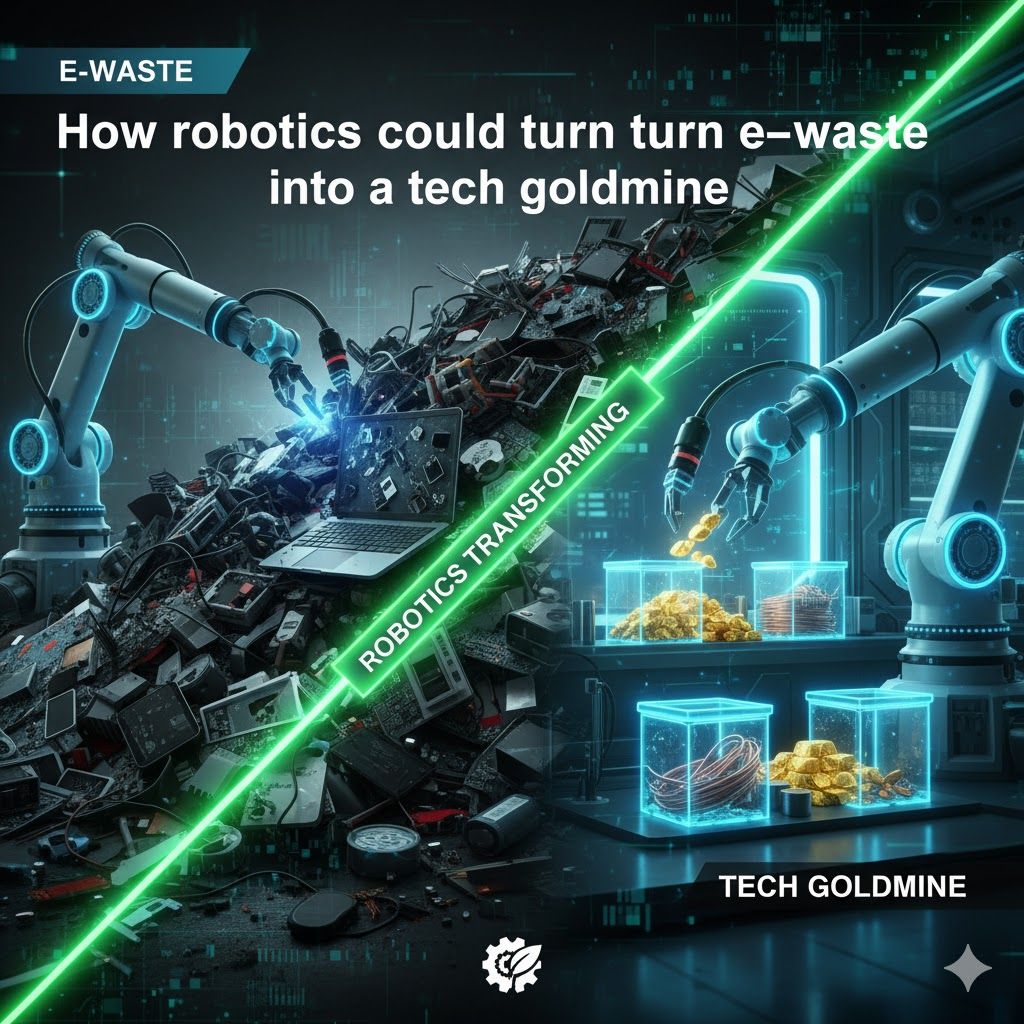
How Robotics Could Turn E-Waste into a Tech Goldmine
The accumulation of electronic waste, ore-waste, has emerged as a critical global challenge. A significant portion of discarded electronic devices ends up in landfills or undergoes processing under hazardous conditions. Disturbingly, approximately78% of electronic productsare not properly recycled, contributing to an ever-growing mountain of refuse.
In2024alone, a staggering1.22 billion smartphoneswere produced. When combined with billions of televisions, laptops, and computers, this volume points to an oversaturated market that perpetuates a "throwaway" culture.
A report from theUnited Nationsprojects that global e-waste will swell to80 million tonnes by 2030.Eric Ingebretsen, Chief Commercial Officer atSK Tes– a company operating40 global IT Asset Disposition (ITAD) sitesand processing hundreds of millions of pounds of electronics annually – emphasizes the scale of this problem: "That’s enough to fill 1.5 million 40-ton trucks, which could circle the planet."
It's evident that the world urgently requires innovative e-waste initiatives that can not only reverse this alarming trend but also foster viable business opportunities.
Robotics Paves the Way for a Circular Tech Economy
At theDanish Technological Institute, researchers are developing anAI-driven robotic systemdesigned to tackle e-waste. This innovative approach aims to scale, modernize, and empower the burgeoning tech refurbishment sector.
During a demonstration,Mikkel Labori Olsen, a consultant in robotics technology at the institute and a researcher on theRoboSAPIENS project(focused on enhancing human-robot interaction safety), showcased his team's work. They are creating a robot that automates the refurbishment of laptops, thereby generating a revenue stream while simultaneously curtailing e-waste.
The system comprises a robotic arm, a specialized toolkit, and a camera. It has been specifically trained to replace laptop screens—a task that is typically manual, time-consuming, and challenging for local businesses to staff due to its tedious nature, as Olsen explained.
Olsen and his team have successfully trained the robot to disassemble and replace screens on two specific laptop models and their submodels. Their ongoing efforts are focused on expanding the robot's screen disassembly capabilities to encompass a wider array of laptop models and brands.
This sophisticated robot employs a combination ofAIandvisual recognitionto adapt to different laptop types. It can precisely remove plastic protectors, unscrew components, and carefully detach screens. A recent video provides a visual demonstration of the system in operation.
"We can drastically reduce waste if instead of throwing a perfectly useful laptop out, we just change the screen and then sell it again," Olsen noted.
Olsen further elaborated on the economic benefits, stating that a refurbished laptop can fetch approximately€200, depending on the region, model, and other variables. In stark contrast, the material value derived from grinding down an entire device for recycling is a mere€10. "The essence is that by changing a few components, and especially a few simple components, you can make a lot of value from it instead of just selling the recycled components," he added.
Challenges and the Untapped Value of E-Waste
However, training theAIthat powers systems like Olsen’s presents significant challenges. If the robot encounters unforeseen events not present in its training data, it may struggle to complete its tasks. Even minor variations, such as different colored screws, can necessitate new AI training to expand the system’s underlying data set.
These unpredictable occurrences highlight the necessity of incorporating"humans-in-the-loop"within robotic systems in the technology recycling industry, Olsen explained. Human operators can intervene to address any issues flagged by the robot.
The intrinsic value within e-waste is remarkably high. A report by theAstute Grouprevealed that a tonne of discarded smartphones yields more gold than a tonne of mined gold ore. "In addition to gold, components like copper, silver, palladium, and rare earth metals are critical for manufacturing the technology hardware that the world demands," statedIngebretsenfromSK Tes.
Despite this immense value, the majority of e-waste materials remain unrecovered. So, why haven't the tech industry or other sectors fully capitalized on this lucrative market?
According to Olsen, the field of e-waste refurbishment and recycling has yet to gain widespread recognition for its significant value, although companies are gradually realizing its potential. Another major barrier is cost, as Olsen highlighted: "Robots and automation are expensive and complex."
An additional hurdle is the sheer diversity of hardware, components, devices, model variations, and the various states in which e-waste products are found. This complexity makes it difficult to design robotic systems that can adapt seamlessly to different e-waste devices without encountering operational snags. The type of highly advanced AI required for such adaptability is still largely in the research and development phase.
Furthermore, as technology becomes increasingly compact, manufacturers are fundamentally altering device construction methods. Components are often glued together instead of being fastened with screws, which complicates disassembly and recycling without causing damage to valuable parts.
A Promising Future for Robotics in E-Waste
Despite these challenges, Olsen maintains an optimistic outlook. He is impressed by the advancements being made by local, European, and international companies that are enhancing their capabilities in tech refurbishment and component recycling.
In Denmark, companies such asTier 1A,Refurb, andGreenminddemonstrate that refurbishment can be a scalable business model. "Some of these companies are aiming to refurbish up to 2,000 units per day," Olsen confirmed.
Olsen and his team are committed to further expanding the capabilities of their robotic system. Their immediate goal is for the system to recognize a broader range of laptop models and submodels. Ultimately, they aspire to develop a production-ready robotic system that can support local Danish tech refurbishment businesses.
His optimism is well-founded: robotics is poised to revolutionize the future of e-waste management and reuse. From Danish laboratories to global recycling facilities,AI-powered systemsare being developed to precisely identify, sort, and dismantle electronic devices.
These sophisticated robots will automate hazardous and labor-intensive tasks, thereby enhancing both safety and efficiency in the e-waste industry. Crucially, they will also unlock the hidden economic treasure trove contained within discarded electronics.