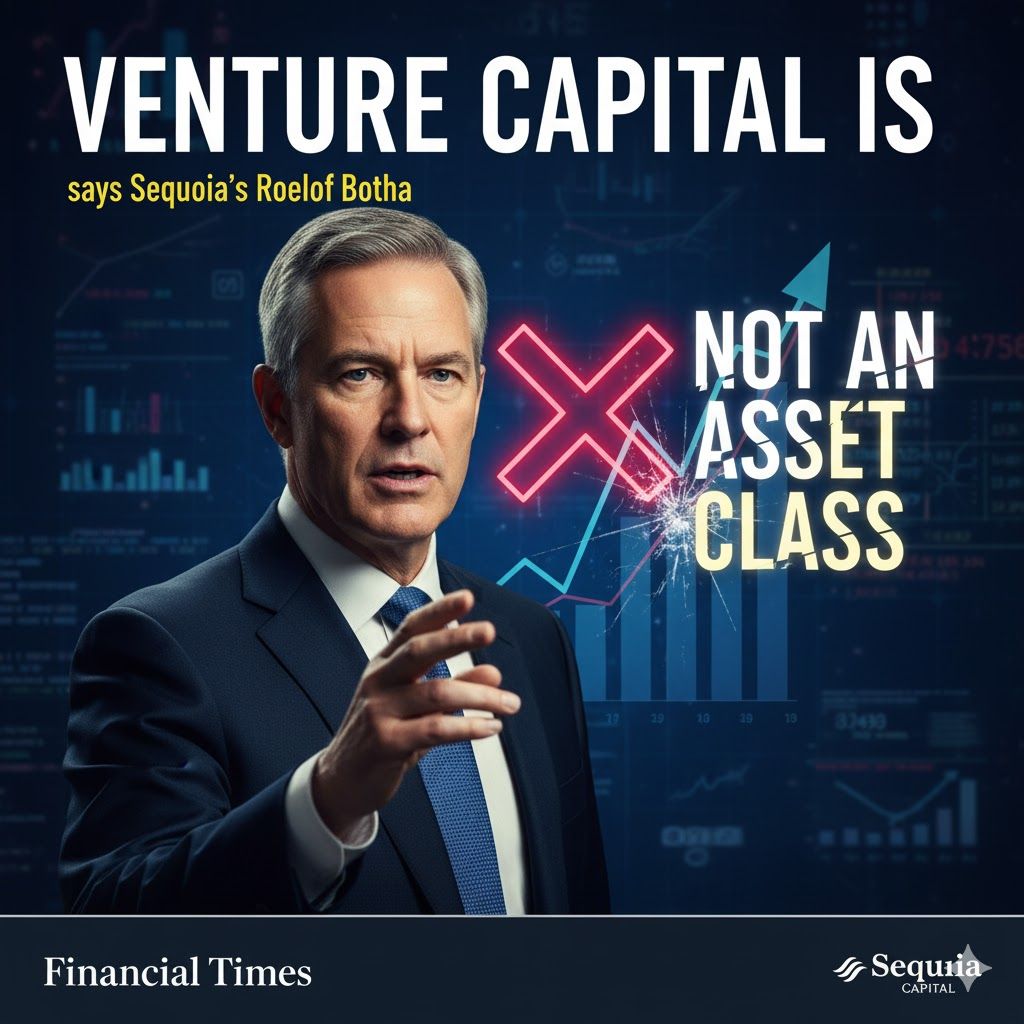
Venture capital is not an asset class, says Sequoia's Roelof Botha
In a thought-provoking assertion that challenges a long-held industry categorization, Roelof Botha, the influential leader of venture capital powerhouse Sequoia, recently declared

Admin
Sequoia's Roelof Botha: Venture Capital Doesn't Fit the Asset Class Mold
In a thought-provoking assertion that challenges a long-held industry categorization, Roelof Botha, the influential leader of venture capital powerhouse Sequoia, recently declared that venture capital, in his view, is not a traditional asset class. This statement from one of Silicon Valley's most prominent figures invites a re-evaluation of how investors and the broader financial community perceive and engage with the high-stakes world of startup funding.
Botha's perspective suggests that the unique characteristics of venture capital distinguish it fundamentally from established asset classes like equities, fixed income, real estate, or commodities. His argument likely stems from several core differences that set VC apart, not merely as an alternative investment, but as a category unto itself.
The Nuances of Venture Capital Investment
One primary distinction lies in theextreme illiquidity and long-term natureof venture investments. Unlike public stocks that can be traded daily or bonds with defined maturity dates, capital committed to a venture fund is typically locked up for a decade or more. Returns materialize through exits – acquisitions or IPOs – which are unpredictable and often take years, if not longer, to achieve. This extended time horizon and lack of immediate liquidity are stark contrasts to conventional assets.
Furthermore, theheterogeneity and idiosyncratic riskassociated with individual venture investments are unparalleled. Each startup represents a unique bet on a novel idea, technology, or market, often without historical data or comparable benchmarks. Success hinges not just on market conditions but heavily on the execution capabilities of the founding team, product-market fit, and even serendipity. This makes diversified portfolio theory, as applied to public markets, a far more complex proposition in venture capital.
Beyond Passive Investment: An Active Endeavor
Botha’s stance also highlights theactive, operational involvementoften required from venture capitalists. Unlike a passive investment in a stock index, VC firms frequently dedicate significant resources to mentoring founders, aiding in strategic decisions, recruitment, and business development. This hands-on approach transforms the investment from a purely financial allocation into an active partnership aimed at company building, further separating it from the transactional nature of traditional asset classes.
Thepower law distribution of returnsis another critical factor. In venture capital, a vast majority of returns are generated by a very small percentage of highly successful investments, while many others fail or yield modest results. This extreme asymmetry makes venture capital a distinct beast, where identifying and supporting future outliers is paramount, rather than relying on broad market movements or consistent dividend yields.
Implications for Investors and the Industry
Botha's statement carries significant implications for institutional limited partners (LPs) and for how the venture capital industry positions itself. If VC is not an asset class, then perhaps it requires a different framework for evaluation, allocation, and risk management. It encourages a shift from treating venture as merely another bucket in a diversified portfolio to understanding its unique demands and potential, as well as its specific contribution to overall portfolio strategy.
Ultimately, this perspective from Sequoia’s head is a powerful reminder of venture capital's unique role in fostering innovation and economic growth. It underscores that while capital is certainly invested, the process is far more nuanced and engaged than simply allocating funds to a predefined asset category.